
 English
 中文简体
 русский
 Español

 Inquiry
Industry News
Home / News / Industry News / How Auto Tint Welding Lens Shade Control Supports Different Industrial Welding Applications
2026-11-27
A welder rarely works under exactly the same conditions throughout a shift. One job may involve low-current TIG welding, where seeing the weld pool clearly is essential. The next may require MIG welding at a higher current, with a much brighter arc. Using the same shade setting for both jobs can make visibility difficult.
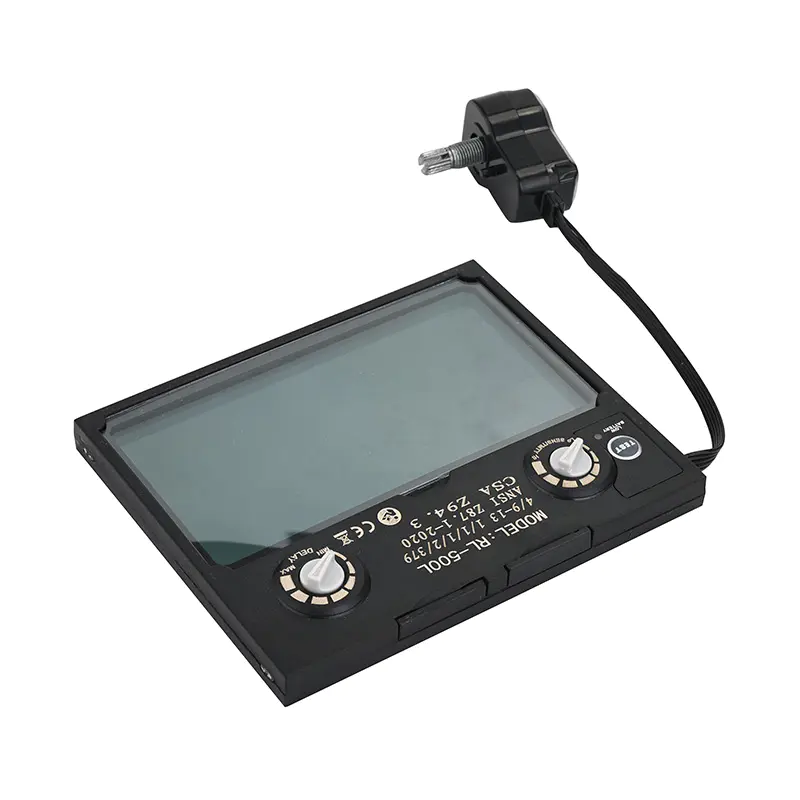
An Auto Tint Welding Lens allows operators to adjust the darkness of the filter to suit different welding conditions. Shade, sensitivity, and delay controls each serve a different purpose. For industrial buyers, understanding these functions helps when comparing welding helmets intended for professional and production-line use.
How Automatic Tint Control Works in Welding Lenses
An auto-darkening lens contains an electronic optical filter and sensors that detect the welding arc. Before welding begins, the filter stays in its light state. The operator can see the workpiece, position the torch, and prepare the joint without repeatedly lifting the helmet.
Once the sensors detect an arc, the filter switches to the selected dark shade. When welding stops, it returns to the light state after the preset delay.
Most adjustable ADF systems provide four main controls:
These settings are related, but they are not interchangeable. Changing the shade does not correct poor sensor detection, and adjusting sensitivity does not determine the appropriate protection level.
Why Different Welding Processes Require Different Shade Settings
TIG, MIG/MAG, stick, and flux-cored welding produce different arc conditions. Current, electrode type, and operating technique all influence the shade required. A setting that provides a clear view during one process may be unsuitable for another.
TIG welding is a good example. At low currents, the arc can be difficult for some ADF sensors to detect. The operator also needs a clear view of the weld pool to control torch movement and filler material. A filter that is too dark makes this work harder.
MIG/MAG and flux-cored welding often involve brighter arcs and considerable spatter. Stick welding introduces different conditions depending on electrode type and current. Plasma cutting also requires an appropriate shade setting, but buyers should confirm that the helmet is specifically rated for the intended cutting application.
| Welding Application | Shade Control Consideration | Main Performance Requirement |
|---|---|---|
| TIG Welding | Suitable shade and reliable detection at low currents | Clear weld-pool visibility |
| MIG/MAG Welding | Settings matched to current and process conditions | Stable arc detection and glare reduction |
| Stick Welding | Shade appropriate for electrode and current range | Consistent switching during operation |
| Flux-Cored Arc Welding | Adjustable settings for varying arc intensity | Reliable performance during extended welding |
| Plasma Cutting | Shade selected according to cutting parameters | Compatibility with the specified cutting mode |
The table is a general application guide, not a list of fixed shade prescriptions. Operators should follow applicable safety requirements and the helmet manufacturer's recommendations when selecting a setting.
How Adjustable Shade Control Improves Industrial Welding Efficiency
In a fabrication workshop, changing welding processes may be part of the normal production routine. Operators might move from thin-section TIG work to heavier MIG welding without changing helmets.
With a variable-shade ADF, they can adjust the dark state instead of replacing the filter. This saves time when several tasks are performed during the same shift and helps maintain suitable visibility for each operation.
The practical benefit is not simply convenience. Excessive darkness can make it difficult to follow the weld pool, while insufficient darkness can expose the operator to an uncomfortable level of visible radiation. Correct adjustment helps maintain a usable view without compromising the required protection.
Some advanced helmets also offer programmable settings or memory functions. These can be useful in workshops where operators regularly alternate between a small number of established welding processes. The available functions vary by model, so buyers should check whether settings can actually be stored and recalled.
The Role of Sensitivity and Delay Controls in Different Environments
Shade is only one part of ADF adjustment. Sensor sensitivity and delay can make a noticeable difference, particularly in workshops where several welding stations operate close together.
Sensitivity Control for Reliable Arc Detection
Sensitivity determines how readily the sensors react to changes in light. Higher sensitivity can help the filter detect weaker arcs, which is useful in low-current TIG applications.
There is a practical limit, however. In a workshop with several active welding stations, light from nearby arcs may trigger an overly sensitive filter. Operators may need to reduce the setting to avoid unwanted switching. Sensor position and the manufacturer's recommended adjustment range should also be considered.
Delay Control for Post-Weld Protection
After the arc stops, the weld area may remain bright for a short period. Delay control determines how long the lens stays dark before returning to its light state.
A longer delay can be helpful during high-current welding or when the hot weld remains intensely bright. A shorter delay may suit repeated short welds where operators need to inspect the work between operations.
The setting should reflect the welding conditions rather than simply being placed at its shortest or longest position. UV and IR protection must remain effective regardless of the selected delay.
Compliance and Optical Performance Buyers Should Evaluate
Adjustable controls are useful only when the filter itself meets the required performance standards. Industrial buyers should check the following specifications before approving a product:
One detail is easily overlooked in OEM purchasing: an ADF certificate does not automatically establish compliance for the complete welding helmet. Buyers should request documentation that identifies the actual filter and helmet configuration being supplied.
How Manufacturers Can Improve Auto Tint Lens Reliability
Electronic performance needs to remain consistent from one production batch to the next. Manufacturers should test more than the basic darkening function. Shade accuracy, switching response, sensor sensitivity, delay adjustment, and operation under representative temperature conditions all deserve inspection.
Power supply reliability is another consideration. Some ADFs use replaceable batteries, solar-assisted power, or a combination of both. Buyers should check battery specifications, low-power warnings, and replacement instructions. These details affect maintenance, especially for helmets used throughout long production shifts.
The outer protective cover lens also needs attention. Welding spatter, dust, and scratches can reduce visibility and interfere with sensor detection. Replacement lenses should be readily available, and maintenance instructions should clearly explain when damaged components need changing.
For OEM orders, manufacturers should document the ADF specifications, adjustment ranges, electronic components, and inspection requirements. Any change to the filter or control system should be checked before it is introduced into mass production.
Selecting the Right Auto Tint Welding Lens for Industrial Operations
A helmet intended for occasional stick welding does not necessarily need the same adjustment range as one used for low-current TIG and continuous MIG production. Buyers should start with the processes their customers perform most often, then compare shade range, sensor response, delay adjustment, and optical performance.
It is also worth testing samples under actual workshop conditions. A filter may perform well in an isolated test but behave differently when several welding arcs are active nearby. Checking these details before placing an OEM order gives buyers a clearer picture of how the lens will perform after it reaches the end user.

Model: RLM 700
Model: RLM 1000
Model: RLM 1100
Model: RLM 800
Model: RLM 900
Model: RLM 1200

Building 7, Zeguo Electromechanical Pioneer Park, No.1 Park Road, Zeguo Town, Wenling,Taizhou City, Zhejiang Province, China
Tel: +86-0576-86442210
FAX: +86-0576-86442210
Phone: +86-15669702909
Copyright © Taizhou Ruiling Optoelectronics Technology Co., Ltd.
Auto Darkening Welding Helmet Factory